Step Into the Dynamic Practice of Regenerative Placemaking — A Live Journey Through Generation Regeneration With Author Tony Cho
Six Weeks. One Living Practice. Guided by the Book — and the Person Who Wrote It.
The Co-Design Cohort is a live journey through Tony Cho’s book, Generation Regeneration — guided by its framework, but built around what only Tony can bring to it: his own experience building the projects behind the book, real case studies pulled straight from the field, and guest practitioners who join the cohort to go deeper on the ideas that matter most to your work
You care deeply about your city. So why does changing it feel so lonely?
You feel it before you can name it. Something about the place you live isn’t working — for you, or for the people around you.
Maybe it’s the isolation. Neighbors who never meet. Streets built for cars, not people. A public square that used to hold a community and now just holds traffic. No shade. No parks. A place designed for efficiency, not well-being.
Maybe it’s more than that — the disconnection, the noise, the lack of green space, the way your environment leaves you depleted instead of nourished. You’re starting to notice it’s not just the place that’s unwell. It’s starting to rub off on you, too.
Tell me if this sounds familiar: you can see what’s broken — physically, socially, even in your own body — but you feel like you’re the only one who notices, or the only one trying to do something about it. You’ve read the books, watched the talks, followed the movement. But every time you try to act, it stalls: against permits, funding, competing priorities, timing, or simply the exhaustion of carrying it without the right people around you.
It isn’t that your vision is too ambitious or your impact too small. It’s that you’ve been trying to heal a place — and yourself — without a guide, a framework, and a group of people actually doing the work beside you, in real time.
There’s a whole cohort of people who feel exactly what you feel — who look at their block, their city, their own health, and think: this could be different. This should be different.
When you find your people — a framework, a practice, and a small group moving through it together, week by week — the isolation lifts. The vision stops being a private burden you carry alone. It becomes something you’re actually building, on a deadline, with backup.
Tell me if this sounds familiar:
- You have ideas for your neighborhood, but you are carrying them alone, with no one around you who truly gets it.
- You have read the books and followed the movement, yet the language stays abstract and the tools stay just out of reach.
- You start projects with real energy, then watch them stall the moment you hit permits, funding, or politics.
- You feel the disconnection everywhere: people living side by side who never meet, places built for cars instead of humans.
- You want to go deeper in your work and your relationships, but everything around you rewards going wider and faster.
You might assume your biggest obstacles are funding, politics, permits, or getting the right people on board.
Those challenges are real. But they usually aren’t the first problem.
The first problem is that most of us were never taught how to read what’s actually making a place — and the people in it — unwell. We feel the symptoms: the isolation, the traffic, the lack of gathering space, the sense that our daily environment is quietly wearing us down. We’re rarely shown how to trace those symptoms to root causes, let alone how to act on them without doing it entirely alone.
So we stay stuck in one of two places: numb to it, accepting an unhealthy environment as just how things are — or aware of it, but isolated, with no framework and no one to actually build with.
Generation Regeneration names that framework. But a book on a shelf is still something you carry alone. The Cohort is what happens when you stop carrying it alone:
- How to recognize what's actually making your environment — and the people in it — unwell, instead of just feeling the symptoms.
- How to involve the people who already belong there, instead of building around them or trying to do it solo.
- How to test small interventions before betting everything on one big idea, so you're never carrying all the risk by yourself.
- How to let the place itself, and the community around it, shape the solution — together, with someone checking your work every week.
Those are the skills that turn a lonely, private ache about your neighborhood into a practiced, tested, finished first step — done with people who feel it too.
Because the future we want isn’t built in isolation. It’s read, coached, tested, and built together, by people who finally found each other.
Are you ready to stop doing this alone — and start doing it on a six-week deadline, with a guide?
The Regenerative Placemaking
Co-Design Cohort
A Six-Week Transformation Practice — Live With Tony Cho.
The Co-Design Cohort is a six-week live experience for city builders, entrepreneurs, designers, and changemakers actively regenerating the places they call home — guided by Tony Cho’s book, Generation Regeneration, and led live by Tony himself.
The book lays out the framework. Tony is what helps you read between the lines — the nuances of what actually happens when you try to apply it in the real world. Each session, he brings his own learnings, experiences, and hard-won takeaways from decades of real projects, and introduces you to ecosystems thinking: seeing your place not as a series of isolated fixes, but as a living, interconnected system.
Here’s the distinction that matters: the book gives you the map. The Cohort is where you walk the terrain.
Reading the Book Alone:
- You get the framework on the page.
- You're on your own translating theory into action.
- No one to pressure-test your ideas or catch your blind spots.
- Progress depends entirely on your own follow-through.
- You finish having read something.
Inside the Co-Design Cohort:
- You get the framework applied live to your specific project by the person who built it.
- You get a structured weekly practice — fieldwork, deadlines, feedback — that forces real momentum.
- A small cohort and Tony troubleshoot your specific stakeholder map, site, and constraints, live.
- Accountability is built in — you report progress, get unstuck, and adjust every single week.
- You finish having built a plan for something you want to build: a tested intervention, a stakeholder map, or a measurement plan.
Each week, Tony draws on the book to ground the conversation, then goes beyond it live — unpacking what worked, what didn’t, and what he’d do differently — so you can apply that same real-world judgment directly to your next place or project before the following session.
By the end of six weeks, you won’t just have finished the book. You’ll have a real intervention in motion, shaped by the people and place it’s meant to serve — and the tools to do this again, on your own, for the rest of your career.
Inside the cohort, you will:
- Move chapter by chapter through Generation Regeneration, live with the person who wrote it — a living discipline you help apply in real time, not a static framework you read about.
- Learn to listen to place — reading its ecological, cultural, and community systems, even if you thought you already knew it well.
- Build and stress-test a real stakeholder map, and strengthen consent-based relationships with the people who shape your community.
- Apply what you're reading to your next place or project, testing and refining a real intervention or milestone every week.
- Build alongside a small cohort of changemakers — and Tony himself — applying the same chapter to their own work, in the same week you are.
By the end of six weeks, you will walk away with:
- A tested proof of concept for a real intervention in your community — not a plan you'll get to "someday."
- A stakeholder map of the people and systems shaping your place, built and pressure-tested with feedback.
- Your own annotated, applied read of Generation Regeneration — marked up against real decisions you actually made.
- A peer community of practitioners creating change in places around the world — the people you call when you're stuck next time.
Created by Tony Cho, founder of Future of Cities, the Co-Design Cohort distills more than 20 years of regenerative placemaking — and the book that captures it — into a living practice you apply wherever you live, starting this week.
Meet Your Guide:
Tony Cho, Founder of Future of Cities
Tony Cho is an impact entrepreneur and regenerative living advocate who has spent decades pushing the boundaries of real estate, urban design, and regenerative living. He is one of the leading voices in the movement to build places that heal the people and the land around them.
His path did not start in a boardroom. Tony was raised in an ashram in Florida, and that upbringing gave him a deep connection to nature and community that has shaped everything he has built since. It is the reason his work begins with the self and the land, not with a blueprint handed down from above.
From the streets of Miami’s Wynwood Arts District to the ChoZen Center for Regenerative Living, a bioregional hub cited by Dan Buettner as a model for a Blue Zone, Tony is dedicating his life to proving that places can be designed to regenerate rather than extract.
He co-founded the Climate & Innovation HUB in Miami and the Phoenix Arts & Innovation District in Jacksonville, and through Metro 1, the Magic City Innovation District, and the Wynwood Arts District, he’s helped reshape many of Miami’s neighborhoods.
These are the same projects referenced throughout the book, and the same projects you’ll study inside the cohort — taught by the person who built them. Through Future of Cities, Tony has also gathered a community of 500+ placemakers, practitioners, builders, organizers, and investors, each rooted in a real place and real work.
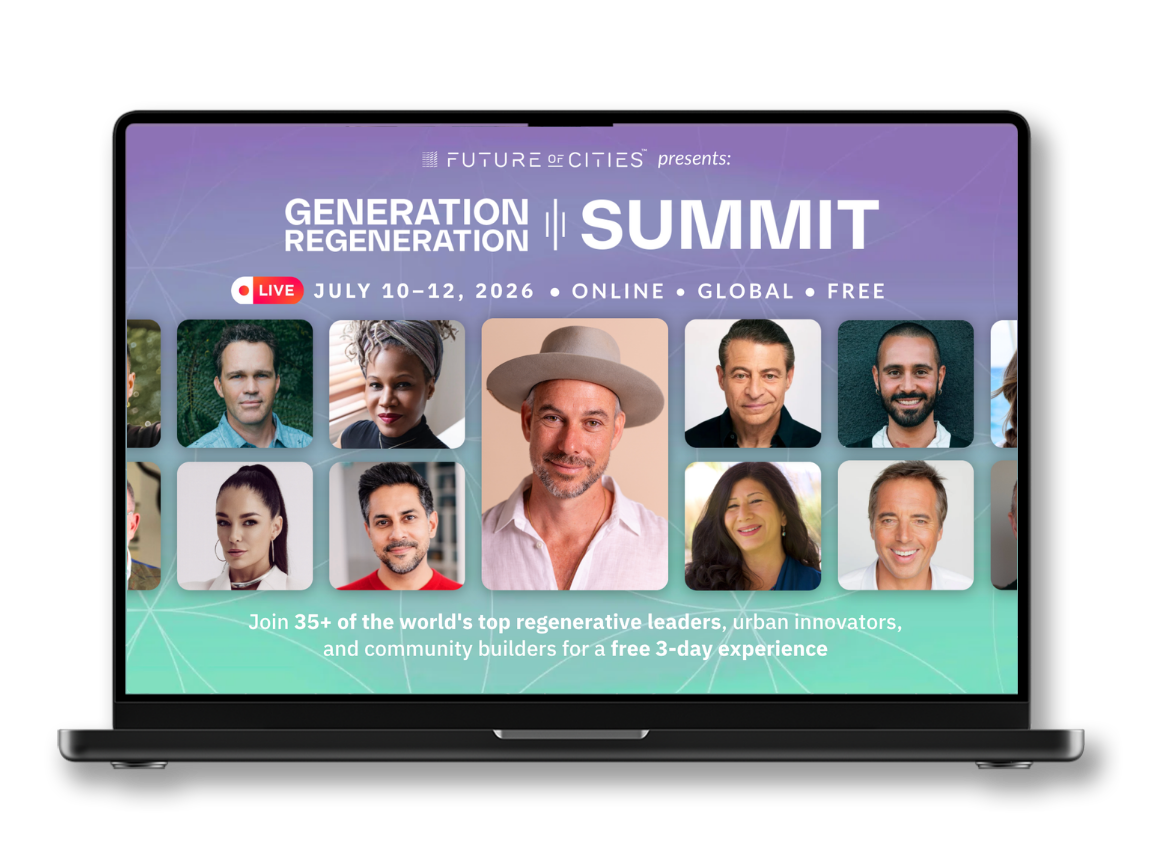
He is the author of Generation Regeneration: Codesigning the Future of Cities Through Regenerative Placemaking — the book this cohort is built around, chapter by chapter — and the host of the Generation Regeneration Online Global Summit, the pre-eminent gathering of the world’s top leaders in this movement.
Tony’s work blends ancient wisdom with modern living, bringing Nature, Community, and Culture together into one grounded practice. He built the Co-Design Cohort to put that practice — and his book — directly into your hands, and to grow what he calls the Regennaissance: a movement of people building the regenerative future, one city at a time.

Tony Cho
Author & Founder, Future of Cities
What People Say About Tony Cho

[Testimonial quote — client to provide.]

[Testimonial quote — client to provide.]

[Testimonial quote — client to provide.]
What's Inside the Co-Design Cohort
Everything inside the Co-Design Cohort is built to do one thing: help you turn what you’re learning into something real and tested by week six.
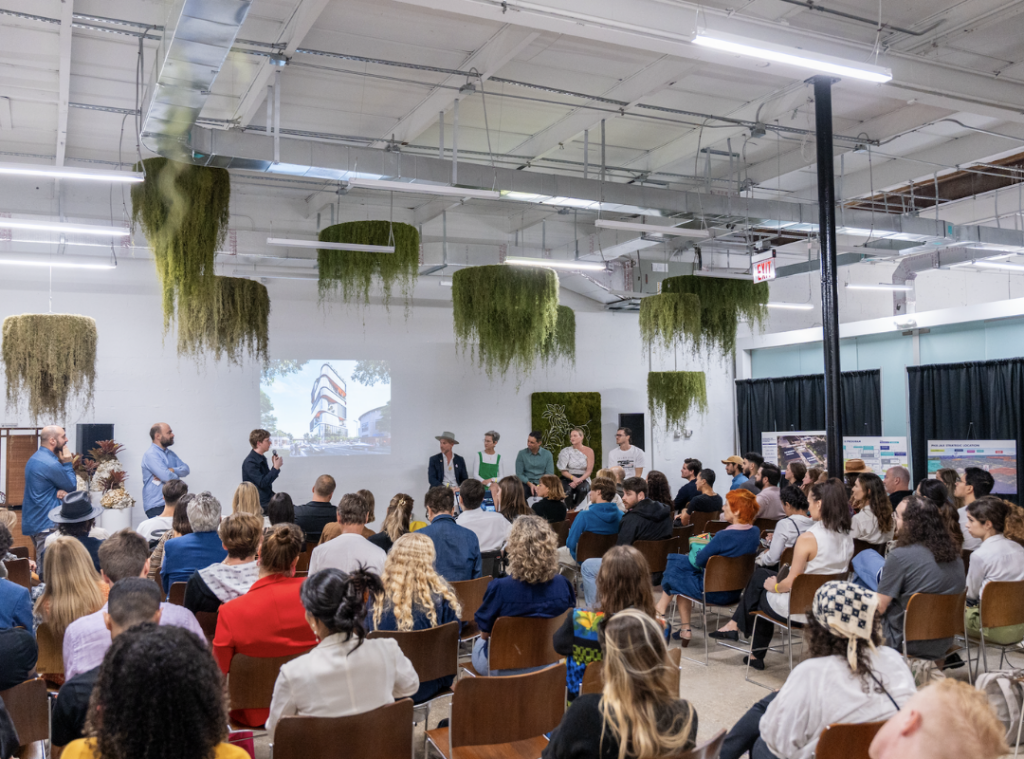
Designed around application, this program is guided by Generation Regeneration but not confined to it — live teaching pairs Tony’s own experience and real case studies from the field with guided fieldwork, a small cohort, and guest practitioners who join along the way, so that what you hear and discuss with Tony becomes something you try on the ground that week. Here’s how it works:
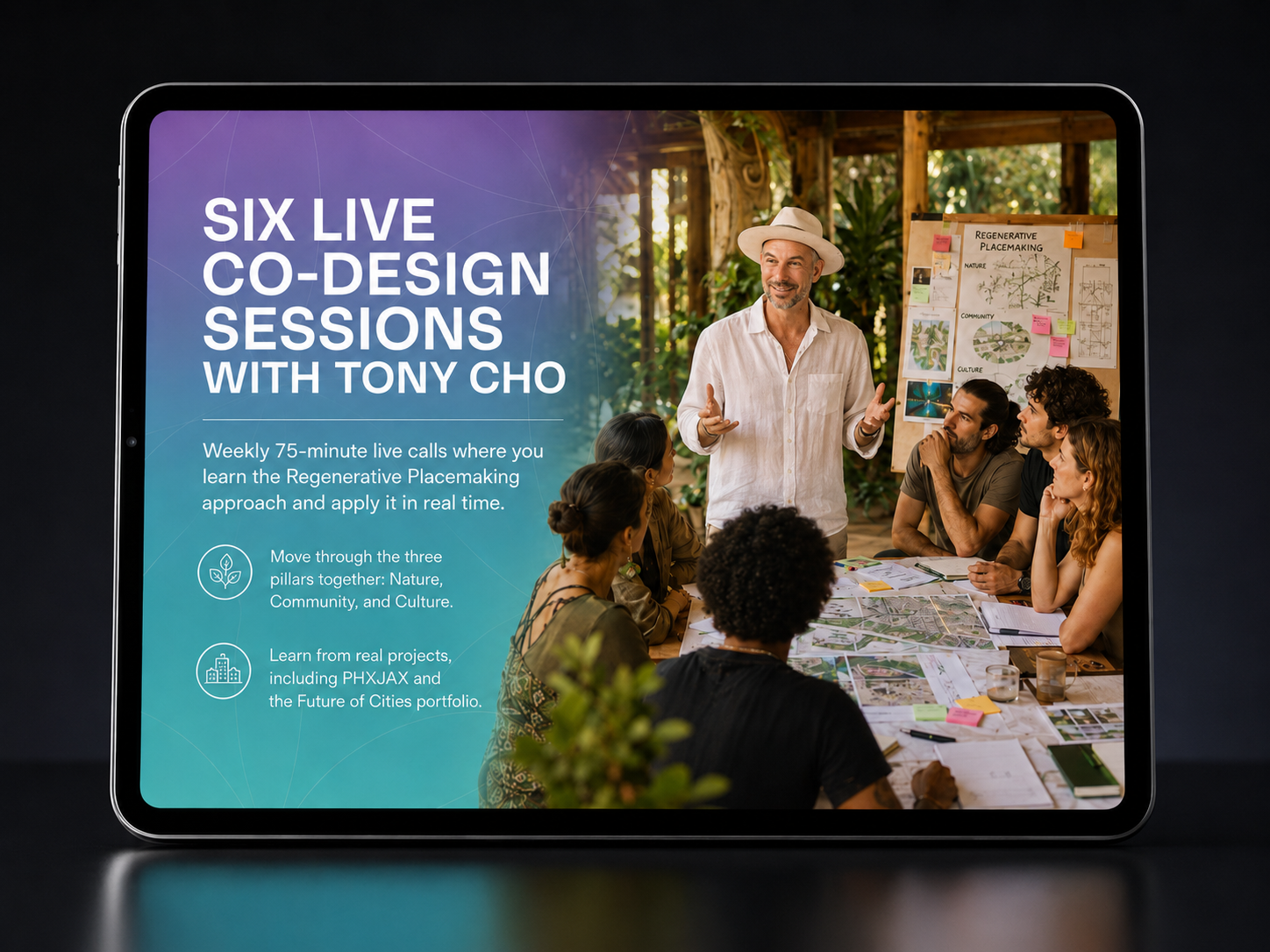
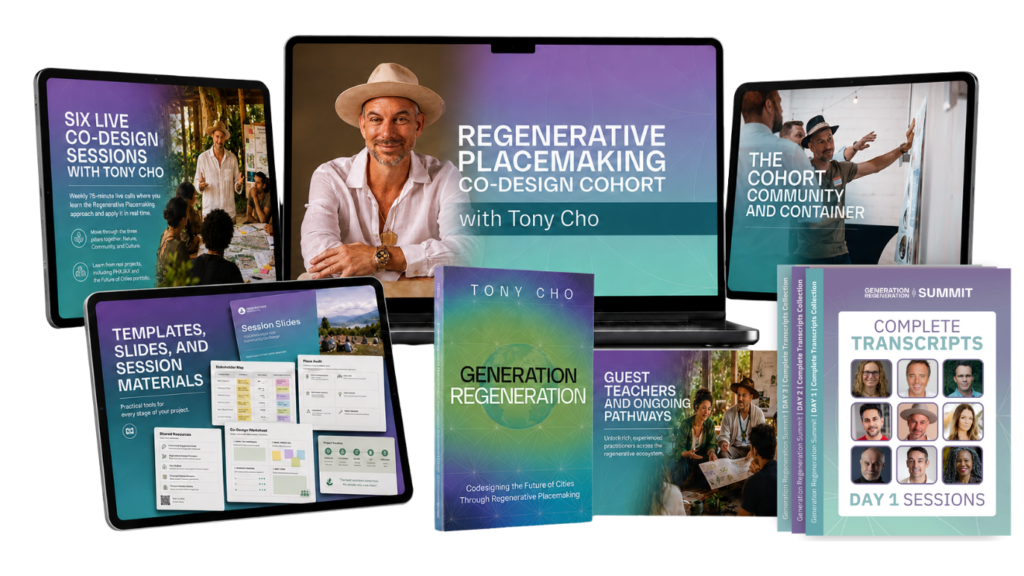
Six Live Co-Design Sessions With Tony Cho — Guided by the Book, Grounded in the Field.
Weekly 75-minute live calls guided by Generation Regeneration’s framework — Tony teaches from his own experience and real case studies, joined periodically by guest practitioners, and you apply it live to your own place or project. Move through the book’s arc together: What Regenerative Placemaking Is, the Three Pillars, Community, Nature, Culture, Measurement, and Policy. Learn from the real projects referenced in the book, including PHXJAX and the Future of Cities portfolio.
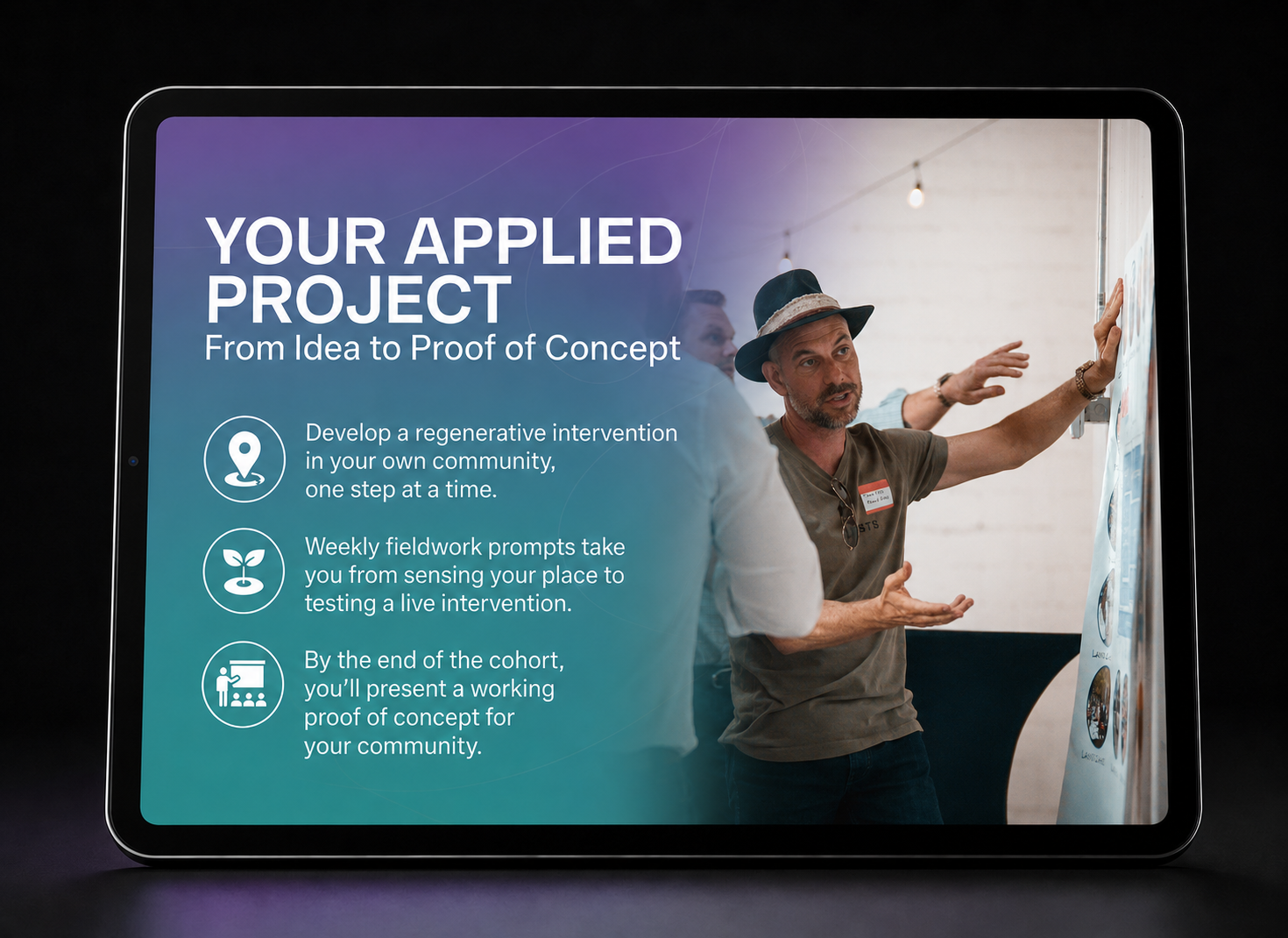
Your Applied Project, From Idea to Proof of Concept.
Develop a regenerative intervention in your own community, one chapter at a time. Weekly fieldwork prompts — drawn from the book’s own toolkits — take you from sensing your place to testing a live intervention. By the end of the cohort, you’ll present a working proof of concept for your community.
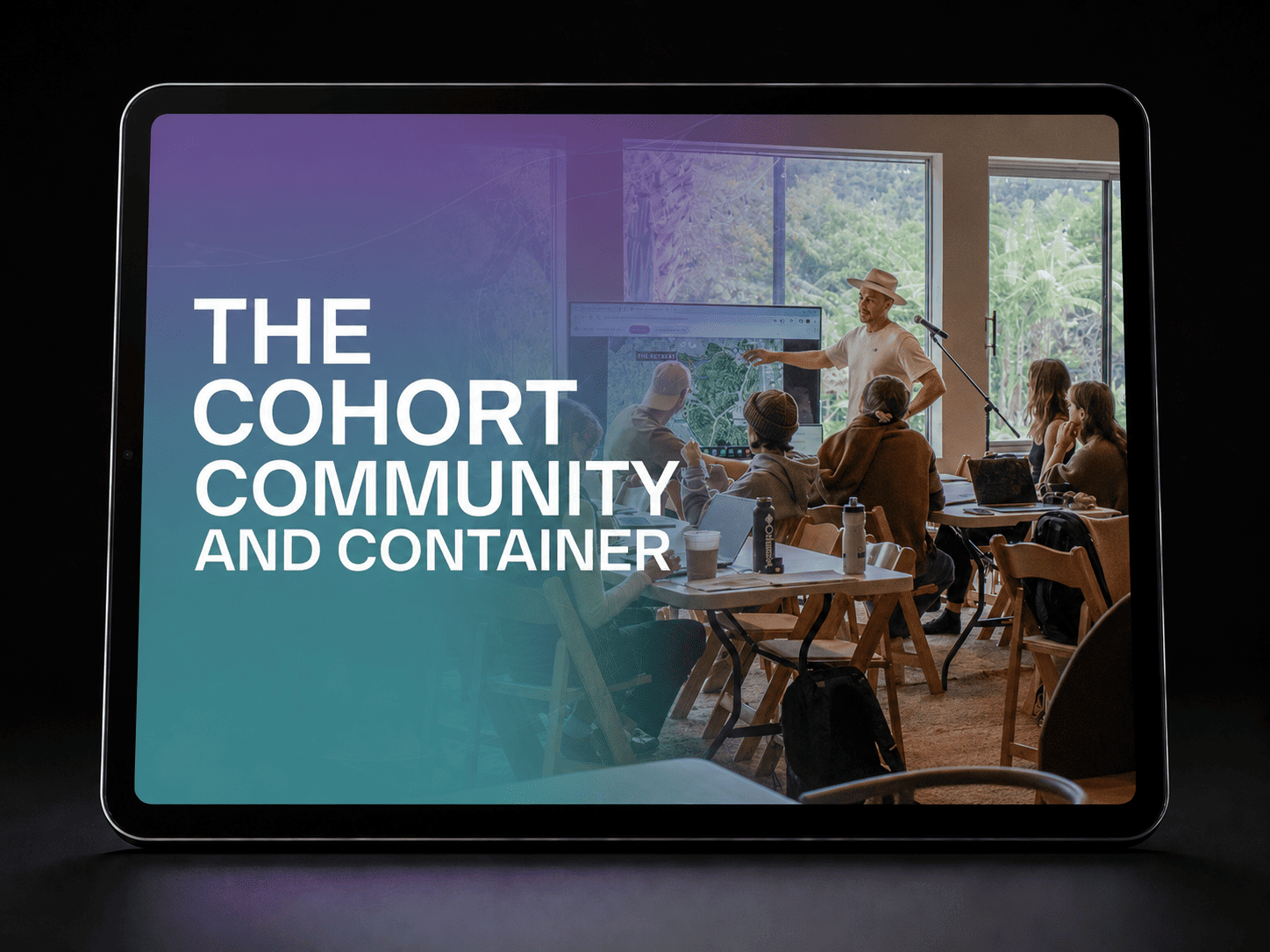
The Cohort Community and Container
Build alongside a small group of changemakers reading and applying the same chapter, in the same week, that you are. Consent-based, place-rooted culture facilitated by the Future of Cities team. Accountability pods, peer feedback, and a community space that stays active between calls.
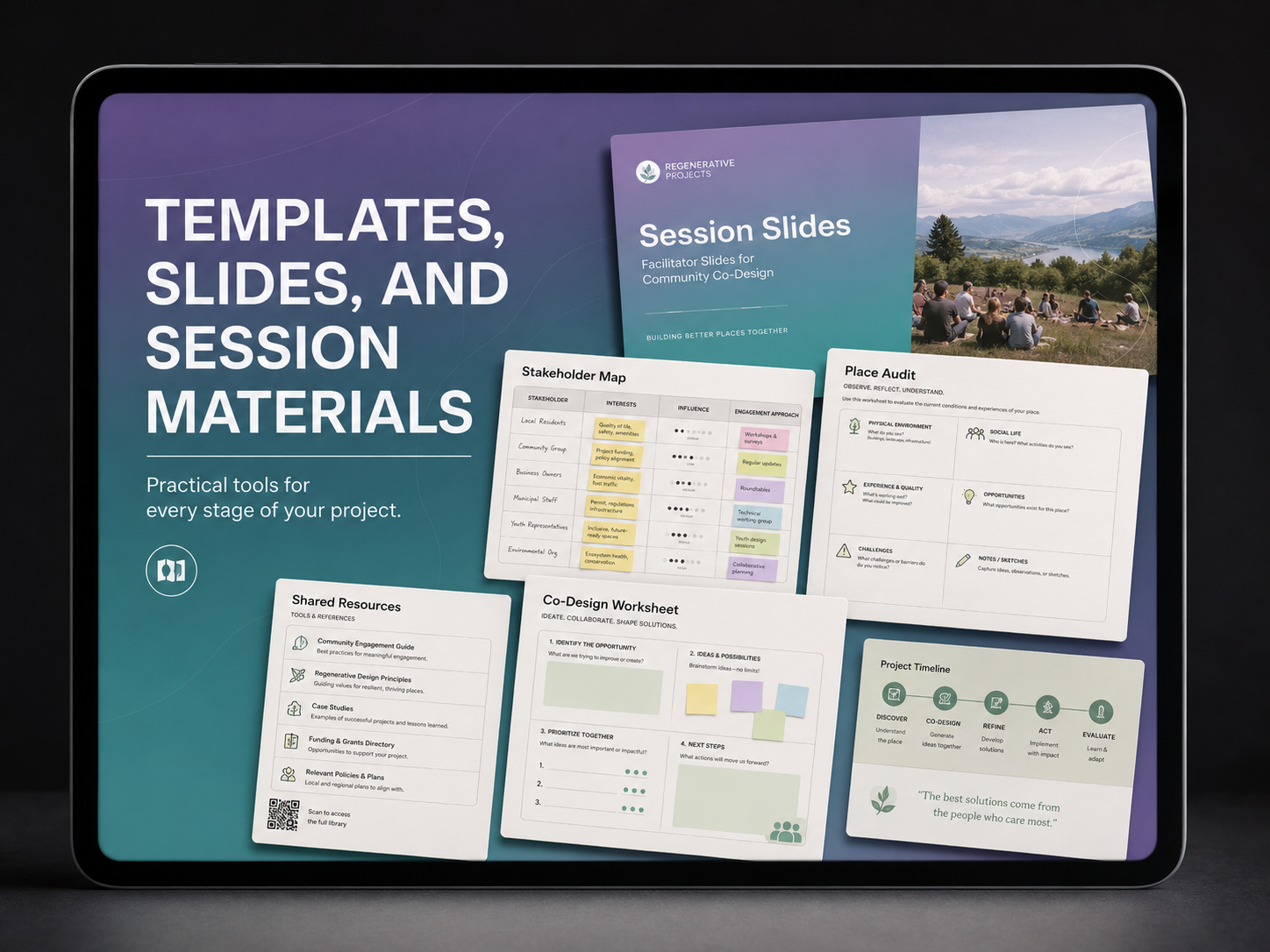
Templates, Slides, and Session Materials.
Get practical tools drawn straight from the book’s toolkits, matched to each week’s chapter. Stakeholder mapping templates, place-audit prompts, and co-design worksheets. Shared cohort resources so you can put each chapter’s ideas into practice.
Recording and Transcript Access
Never lose a session, and revisit the teaching whenever you need it. All live calls recorded and posted within 48 hours, with transcripts for accessibility for a full year.
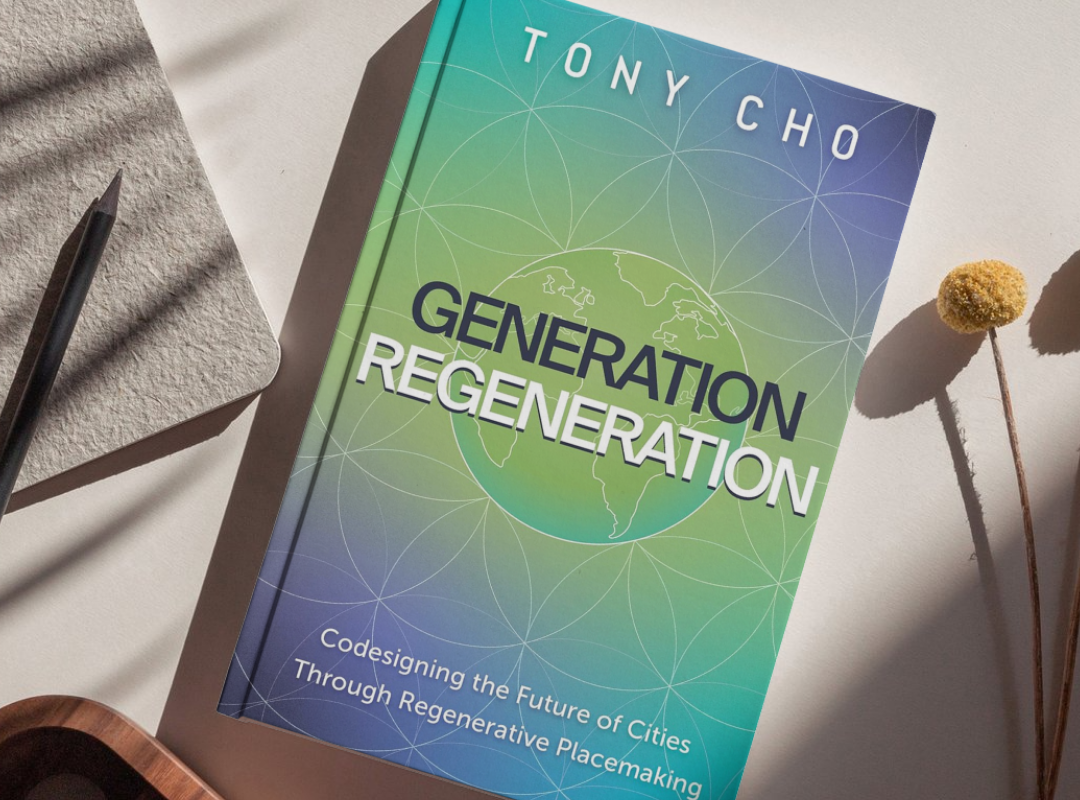
Your Copy of Generation Regeneration
Tony Cho’s forthcoming book (launches on August 11th, 2026) — the text the entire cohort is built around — included with your place in the cohort. Read one chapter a week, right alongside the cohort, as you apply it in your own community.
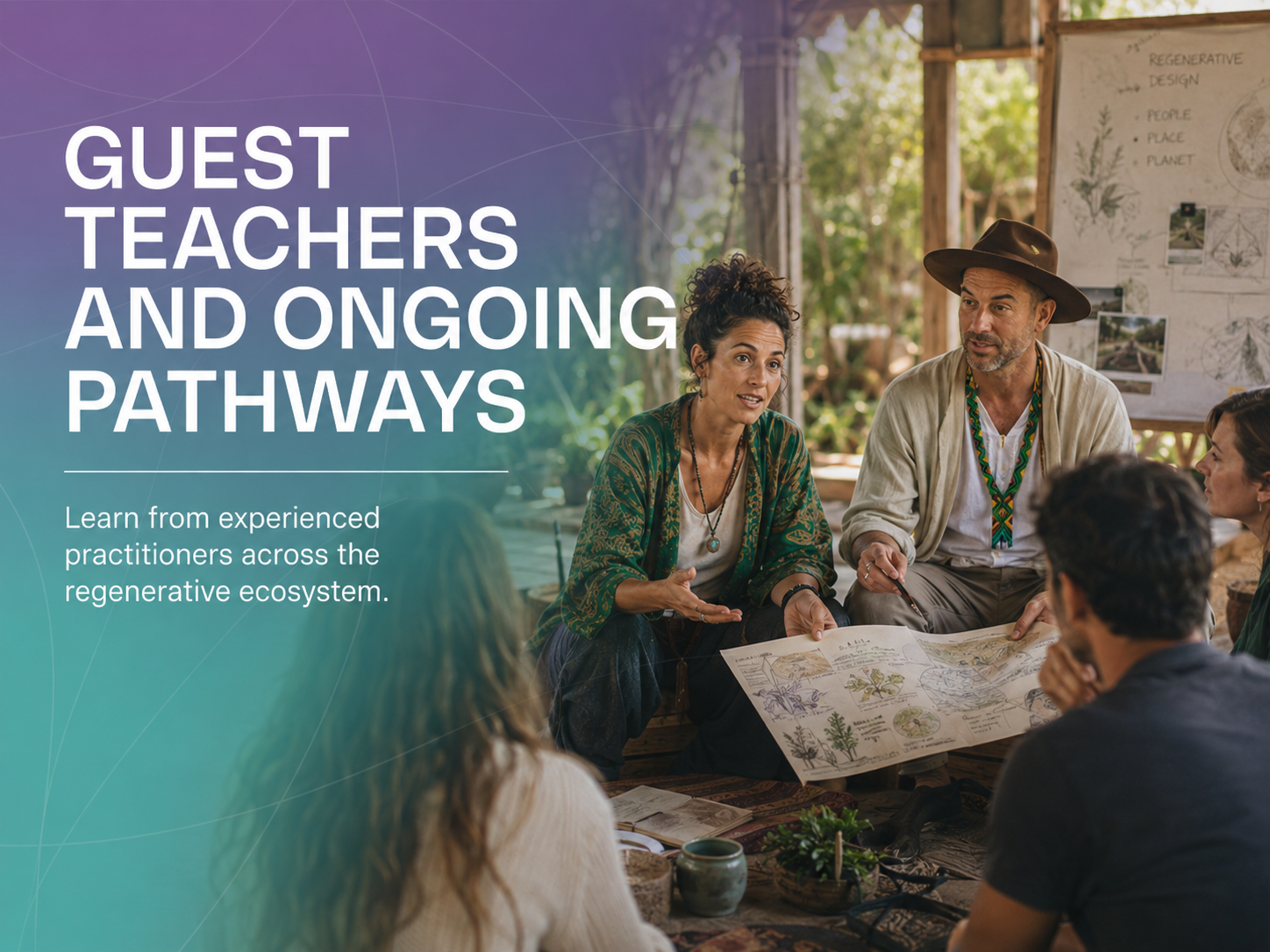
Guest Teachers and Ongoing Pathways.
Continue learning from experienced practitioners across the regenerative ecosystem. Guest sessions with a community stakeholder and a regenerative financing expert. Optional alumni gatherings and an ongoing community of practitioners after the cohort ends.
Every part of the Co-Design Cohort supports the same goal: helping you read, apply, and live the book — and in doing so, build the knowledge, relationships, and experience to regenerate the places you care about.
What You'll Learn Inside the Co-Design Cohort
By the end of six weeks, you’ll have read Generation Regeneration chapter by chapter alongside its author, engaged real stakeholders in your own community, and developed a tested project grounded in your local context — not a framework you understand in theory, but a practice you’ve already run once.
You’ll learn how to:
- Read and practice the Regenerative Placemaking framework (Nature, Community, Culture) as a living discipline — applying it to your next place or project, not just describing it.
- Read your place beneath its surface: its watersheds, its history, its power structures, and the stories that have been celebrated or erased.
- Map the stakeholders who shape your community and build consent-based relationships with them, including voices that are often overlooked.
- Design a small, testable intervention, then measure, adapt, and refine it in the real world — instead of waiting for the "perfect" big plan.
- Fund and sustain regenerative work using financing and participation models that support long-term impact.
- Build alongside a cohort of peers who become trusted collaborators long after the program ends.
This isn’t a one-time skill. It’s a practice you’ll return to on every place, project, and community you help regenerate for the rest of your career — which is exactly why the tools and relationships you leave with matter more than the six weeks themselves.
Your Six-Week Path, One Chapter of Generation Regeneration at a Time
The Co-Design Cohort follows the book’s own sequence. Each week, you read the assigned chapter before the call, then spend 75 minutes live with Tony unpacking it and applying it directly to your next place or project. What you read on the page becomes something you test on the ground before the following week — so the book sharpens work that’s already underway, rather than starting you over from scratch.
Week 1 — See Your Place With New Eyes
- Reading: Introduction ("Welcome to the Regenaissance") + Chapter 1 ("Regenerative Placemaking—What on Earth Is It?")
You open with the origin story of the framework and the core question the whole book is answering: what regenerative placemaking actually is, beyond the dictionary definition. Through an opening circle, live teaching, and one of Tony’s real case studies, you learn to see your place as a living system rather than a set of problems to fix. By the end of the week you’ve mapped your own place at a first pass and named the one spot near you that already feels alive, and why.
Week 2 — Why Three Is a Magic Number
- Reading: Chapter 2 ("Why Three Is a Magic Number in Regenerative Placemaking")
You go inside the framework’s core structure: the three pillars — Nature, Community, Culture — and the practice of thinking generations past and generations ahead before you build. Tony walks you through how this three-part lens changes what you notice in a place. Your fieldwork is a first three-pillar map of your own project: what’s already there for Nature, Community, and Culture, and where each one is thin.
Week 3 — Building Bonds Beyond Bricks
- Reading: Chapter 3 ("Building Bonds Beyond Bricks") — the Community pillar
Now you turn to the people. You learn who holds power in a place, how hidden networks and dependencies work, and how to tell regenerative relationships from extractive ones. Together the cohort live-models a stakeholder map using the book’s own Community toolkit, then you build one for your own place and identify the three to five people you’ll actually reach out to and talk with this week.
Week 4 — Embracing the Green Pulse
- Reading: Chapter 4 ("Embracing the Green Pulse") — the Nature pillar
You go deeper into ecological literacy: watersheds, native species, and the idea that humans aren’t separate from nature but an expression of it. Tony walks you through reading a real place’s natural systems layer by layer. Your fieldwork is a personal place audit using the book’s Nature toolkit — walking your project site morning, afternoon, and evening, and noting what’s already alive there.
Week 5 — Celebrating the Soul of the City
- Reading: Chapter 5 ("Celebrating the Soul of the City") — the Culture pillar
You turn to the layer most placemaking overlooks: rituals, customs, language, and the stories a place tells about itself. Using the book’s Culture toolkit, you learn to surface the cultural assets already present in your community rather than importing culture from elsewhere. Your fieldwork is a short interview with a long-time resident or elder about the history and traditions of your place.
Week 6 — Measure What Matters & The Bridge Between Ideas and Reality
- Reading: Chapter 6 ("Measure What Matters"), Chapter 7 ("The Bridge Between Ideas and Reality") + Conclusion ("Emerald Cities")
You bring it all together. Tony teaches how to measure progress against Nature, Community, and Culture without reducing it to a single score, and how policy is the bridge that carries a good idea into something that lasts. Each participant presents their intervention and what they learned; Tony offers synthesizing reflections on what emerged across the cohort, drawing on the book’s closing vision of the “Emerald City” as a symbol of regenerative practice in action. You leave with a proof of concept, a measurement plan, a peer network, and a finished read of the book you can keep returning to.
By the end of six weeks, you’ll have read Generation Regeneration cover to cover alongside its author, applied every chapter to a real place, tested an intervention in your community, and built relationships with peers who continue the work alongside you. The cohort may end, but the book — and your part in shaping the practice it describes — continues wherever you choose to apply it next.
What Leaders Are Saying
About Generation Regeneration

Tony Cho is a placemaking visionary who combines spiritual enlightenment, a mission to preserve the environment, and decades of real estate development success. He knows how to dream and really manifest it.

Cho offers practical solutions rooted in optimism and bold thinking, perfectly aligning with the challenges of our time. His work is essential reading for anyone who believes that our cities and communities can not only sustain us but regenerate us.

A complete and thorough introduction to the world of regenerative placemaking. Totally accessible to all, and a reminder that hope is far from lost for this planet.
What You Also Get When You Join
Beyond the six live sessions, your place in the cohort comes with everything you need to keep the work — and the book — alive long after week six.
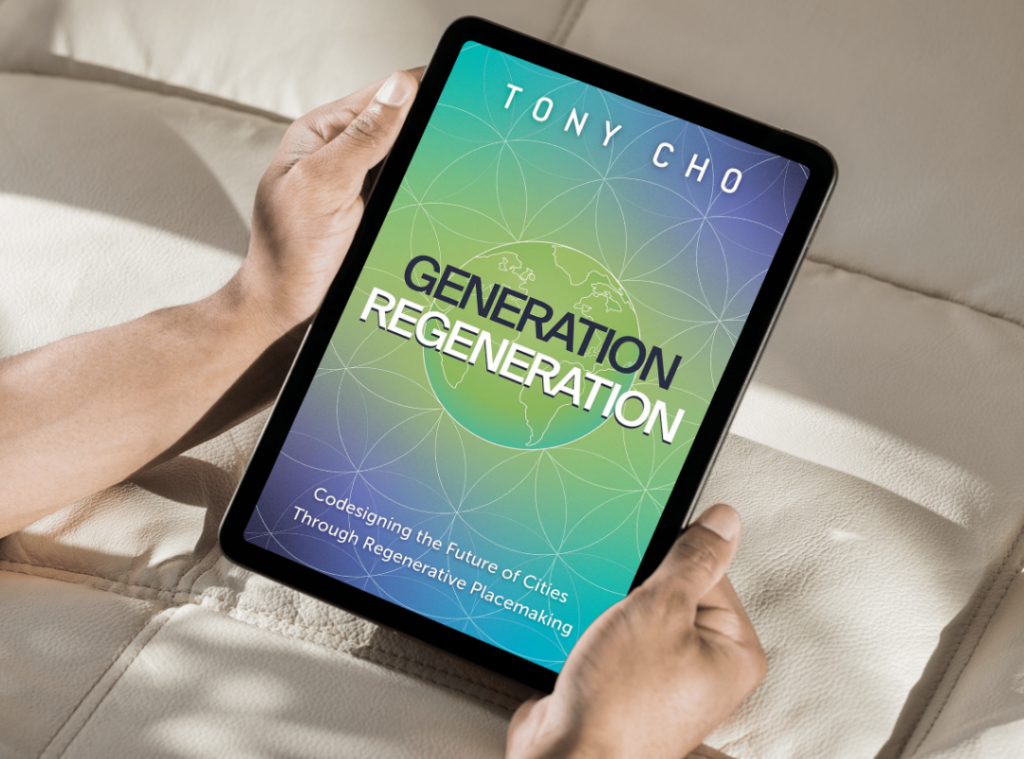
Your Copy of Generation Regeneration
Tony Cho’s book, included with your enrollment — the same book the cohort is sequenced around, in your hands as you build. (Publishing Aug 11, 2026.)
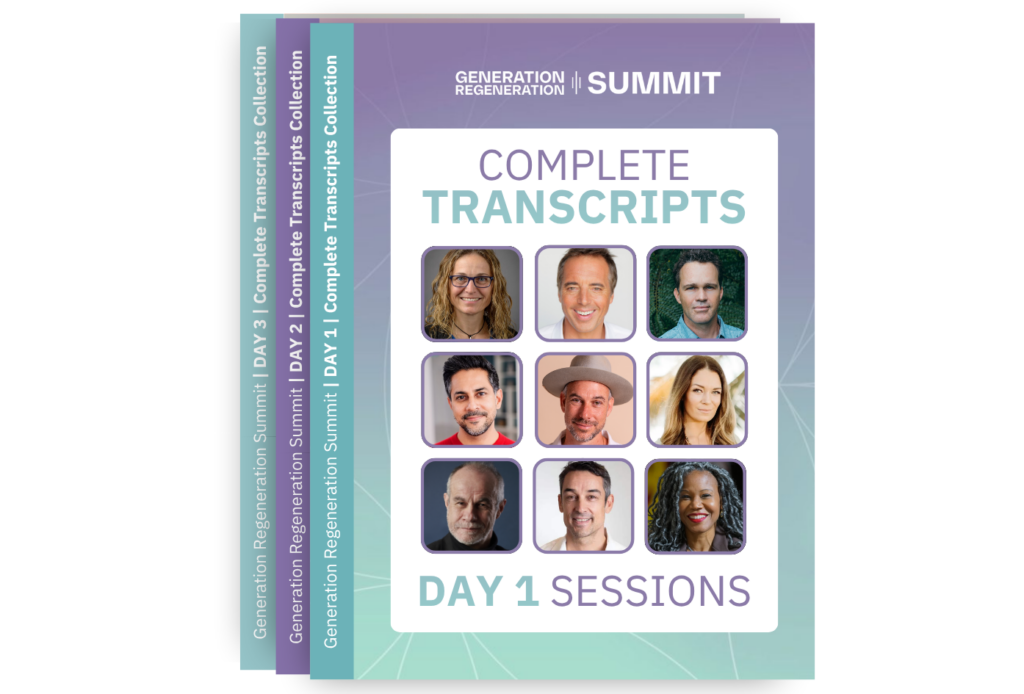
Recording and Transcript Access
Every live session recorded and posted within 24 hours, with full transcripts for accessibility, so you never lose a call and can return to the teaching whenever you need it.
The Alumni Network and Ongoing Pathways
Your cohort does not disband at week six. You keep access to the community space and an invitation to ongoing alumni gatherings (quarterly virtual and annual in-person), so the collaborations you start here can keep growing.
Total Bonus Value: TBD (Included Free When You Join Today)
What You Get When You Join Today
- Six live Co-Design sessions with Tony Cho, one chapter of Generation Regeneration at a time
- Your applied project, guided from idea to a tested proof of concept
- The cohort community and container, held by the Future of Cities team
- Templates, slides, and session materials drawn from the book's own toolkits
- BONUS: Your copy of Generation Regeneration
- BONUS: Recording and transcript access
- BONUS: The alumni network and ongoing pathways
Standard Rate: $1,111
Co-Creator members take an additional 11% off at checkout.
(Early access pricing. The standard rate is $1,111 after the summit.)
What Leaders Are Saying
About Generation Regeneration
Generation Regeneration offers a blueprint for a future where cities and communities thrive in harmony with the natural world.
Generation Regeneration is a powerful and timely contribution that distills the potential of these ideas into something accessible to everyone. It shows that living regeneratively is not only the realm of practitioners and professionals—it is a meaningful, essential pathway for all of us who care about the future of our cities and communities

Before picking up Generation Regeneration, I didn’t realize how much our cities—and our lives—could be transformed by this revolutionary concept. Tony Cho breaks down complex ideas into something simple, accessible, and downright inspiring.
Frequently Asked Questions
Who is this cohort for?
The Co-Design Cohort is for people already stewarding a place and actively working on a project: city planners, architects, developers, nonprofit leaders, artists, cultural organizers, community advocates, social entrepreneurs, impact investors, landowners, and food systems workers. If you’re already in the work, ready to read Generation Regeneration as a working manual rather than a shelf book, and want to go deeper than theory, you’ll be right at home here.
Do I need to read the book before each call?
Yes, ideally the assigned chapter — each week’s live session is built directly around it, and you’ll get the most out of the call having read it first. That said, the framework is taught live too, so you won’t be lost if you fall a chapter behind; you’ll just want to catch up before the next session.
What will I actually have by the end of six weeks?
You’ll have read Generation Regeneration cover to cover with its author, and you’ll leave with a tested proof of concept for a real intervention in your community, a stakeholder map of the people and forces shaping it, and practical experience applying every chapter of the book. You’ll also leave with a cohort of peers doing meaningful work in communities around the world, many of whom become long-term collaborators.
When does it run, and what is the time commitment?
The cohort meets live on Wednesdays from 5:30 to 6:45 PM ET, running September 30 to November 4 or 5, 2026 — one chapter of the book per week. Beyond the 75-minute weekly call, plan for a few hours of reading and fieldwork each week: finishing the chapter, walking your neighborhood, talking to stakeholders, and testing your intervention. Live participation is highly encouraged, as much of the learning comes through discussion, collaboration, and feedback from Tony and the cohort.
What if I miss a live session?
You won’t fall behind. Every call is recorded and posted within 24 hours, with full transcripts for accessibility, so you can catch up on your own schedule. We encourage you to join live whenever possible, since each session includes discussion, collaboration, and peer feedback tied to that week’s chapter.
Is this a fixed framework, or does it change?
Regenerative Placemaking is a living practice, not a fixed formula, and the book reflects that. Tony continues to co-develop it through real projects, and inside the cohort you’ll read it and learn it as it evolves — applying it to your next place or project, and helping shape what it becomes.
Do I need an existing project?
No — the cohort is open to people with a real project already in motion, an early-stage or theoretical idea, and anyone who wants to be in the field and contribute, even without a project of their own yet.
Each chapter of Generation Regeneration is your coursework for that week’s session, along with its corresponding toolkit. The first four sessions are built as a 40-minute live teaching from Tony — covering the framework’s foundation, then each pillar (Community, Nature, Culture) with real project examples and a walkthrough of that chapter’s toolkit — followed by open Q&A. The final two sessions shift into application: bringing your own project (real or in-progress) to the group for feedback, testing an intervention, and refining your next step with Tony and the cohort.
If you’re still in the idea stage or just want to build fluency in the practice, you’ll get just as much out of the first four sessions as someone with a live project — and you’ll have two full sessions to start applying it once you’re ready.
What if I don't know what project I want to work on yet?
That’s completely fine. The first weeks of the cohort — and the opening chapters of the book — are designed to help you understand your place, identify meaningful opportunities, and choose a project you can begin developing throughout the program.
What platform do you use?
Live sessions run on Circle, with a cohort community space for connection and peer feedback between calls, plus a shared drive of templates and session materials keyed to each chapter. The Future of Cities team will make sure you’re set up before the cohort begins.
Is financial assistance available?
Yes. Sliding-scale pricing is available upon request. If cost is a barrier, reach out to our team and we’ll do our best to find an option that works.
What happens right after I join?
You’ll receive a confirmation email with everything you need to access the community, get your copy of the book, prepare for Week 1, and get started with confidence.
What You Get When You Join Today
- Six live Co-Design sessions with Tony Cho, one chapter of Generation Regeneration at a time
- Your applied project, guided from idea to a tested proof of concept
- The cohort community and container, held by the Future of Cities team
- Templates, slides, and session materials drawn from the book's own toolkits
- BONUS: Your copy of Generation Regeneration
- BONUS: Recording and transcript access
- BONUS: The alumni network and ongoing pathways
Standard Rate: $1,111
Co-Creator members take an additional 11% off at checkout.
(Early access pricing. The standard rate is $1,111 after the summit.)